NPN transistor

Trying to understand how the transistor works and verify it with an experiment.
§ Study 1: Saturated transistor
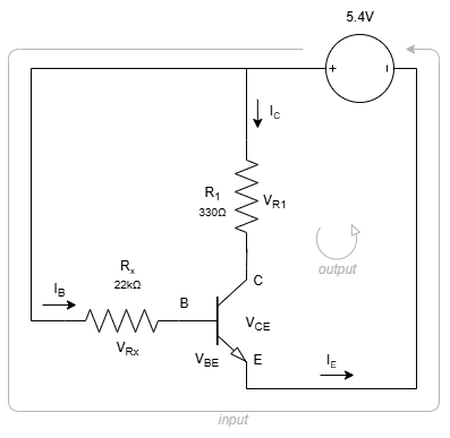
§ Calculations
Transistor common-emitter current gain $$ \beta = 200 - 450 \ $$
Fix forward voltage drop on base $$ V_{BE,sat} = 0.7V $$
Calculate following values
$$ I_{C}, I_{B}, I_{E}, V_{R_{X}}, V_{R_{1}}, V_{CE} = ? $$
Using Kirchoff's voltage law for the input circuit
Using Ohm's law
Using common-emitter current gain
Such current on the collector is impossible, because then it would mean that the voltage on \(R_{1}\) is
This is non-sense because then between the transistor's collector and emitter will be negative voltage.
In this case we must perform reality check
And then the real current on the collector should be
The transistor will saturate long before the \(I_{C}\) reaches \(94.5mA\). In the saturation the \(I_{C}\) is determined by the output circuit (\(V_{CE}\) and \(V_{R_{1}}\)), and not by \(\beta\).

\(V_{CE,sat}\) I just took from internet, but later I checked the datasheet and for \(I_{C} \approx 15mA\) it is to be around \(100mV = 0.1V\).
At last according to Kirchoff's current law
§ Measurements
| Parameter | Expected | Measurement 1 | Δ (%) | Measurement 2 | Δ (%) |
|---|---|---|---|---|---|
| \(V_{0}\) | \(5.40V\) | \(5.25V\) | \(0.15V~(2.78\%) \) | \(5.38V\) | \(0.02V~(0.37\%)\) |
| \(V_{R_{X}}\) | \(4.70V\) | \(4.58V\) | \(0.12V~(2.55\%)\) | \(4.65V\) | \(0.05V~(1.06\%)\) |
| \(V_{R_{1}}\) | \(5.30V\) | \(5.20V\) | \(0.10V~(1.89\%)\) | \(5.26V\) | \(0.04V~(0.75\%)\) |
| \(V_{CE}\) | \(0.1V\) | \(0.11V\) | \(0.01V~(10\%)\) | \(0.11V\) | \(0.01V~(10\%)\) |
| \(V_{BE}\) | \(0.7V\) | \(0.73V\) | \(0.03V~(4.29\%)\) | \(0.73V\) | \(0.03V~(4.29\%)\) |
| \(I_{B}\) | \(0.21mA\) | \(0.20mA\) | \(0.01mA~(4.76\%)\) | \(0.21mA\) | \(0mA~(0\%)\) |
| \(I_{C}\) | \(16.06mA\) | \(14.85mA\) | \(1.24mA~(7.53\%)\) | \(15.48mA\) | \(0.58mA~(3.61\%)\) |
| \(I_{E}\) | \(16.27mA\) | \(15.56mA\) | \(0.71mA~(4.36\%)\) | \(15.66mA\) | \(0.61mA~(3.75\%)\) |
| \(\beta_{sat}\) | \(55\) | \(74.25\) | \(19.25~(35\%)\) | \(73.71\) | \(18.74~(35.02\%)\) |
A note about how I figured out the expected \(\beta_{sat} = 55\): according to my conversation with LLM deep in the saturated mode the value of common-emitter current gain drops to 10-50% of gain in active mode, and I used the higher limit since we are very generous with \(I_{B}\). The gain in active mode I found in the datasheet to be approx. 110, for \(I_{C}=16mA\) and \(V_{CE}=5V\). In the measurement the drop is 67% which is also reasonable outcome.
§ Conclusions
The second measurement has more accurate source voltate, so the error region is lower. The base current and the base-emitter voltage wer quite steady and accurate. The common-emitter gain went wild, but I learned that this value makes only in the active mode. I find this exercise succesful.
TODO: go again about it. Focus more about how I learned about the reality check, and how I unerstood how hFE is not reliable for calculations.
The transistor’s hFE in saturation is lower than in active mode but not zero.
§ Study 2: active transistor
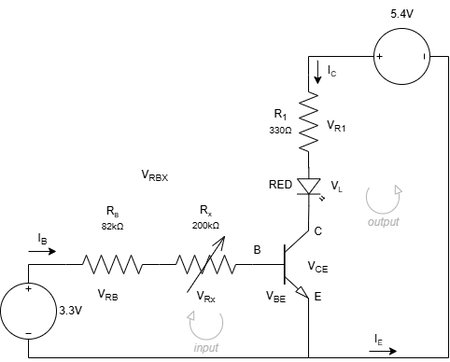
§ Calculations
Transistor common-emitter current gain $$ \beta = 200 - 450 \ $$
Fix forward voltage drop on base $$ V_{BE,on} = 0.66V $$
Calculate following values
$$ I_{C}, I_{B}, I_{E}, V_{R_{BX}}, V_{R_{X}}, V_{R_{B}}, V_{R_{1}}, V_{CE} = ? $$
Let's start again with the input circuit.
Now we can figure out the conventional current flowing into the base. Since we are using potentiometer, I will calculate 2 cases: minimum potentiometer resistance \(0\Omega\), and maximum resistance \(200k\Omega\).
Now I didn't want to again rely on \(\beta\) even if we are aiming for an active mode. But I don't know any other way how to find anything without employing some wild assumpted values that LLM suggest, even I didn't find or extrapolate them myself from the datasheet.
Anyway here is what I have tried: I found in LED datasheet that \(V_{L}\) will be around \(2.1V\). The using Kirchoff's volate law on the output circuit.
There are two unknowns - \(I_{C}\) and \(V_{CE}\).
Let's imagine \(V_{CE}\) is would be not there. Then
If \(V_{CE}>0V\), then \(I_{C}<10mA\).
Next imagine \(V_{CE}\) is there, but the transistor is saturated. Then
Saturated transistor's \(V_{CE}\) should be less that active transistor's \(V_{CE}\). So the \(I_{C} < 9.6mA\). That din't help a lot.
So I am giving up. Let's use \(\beta\). Now, in the active mode, it should be in the range of the values stated in the datasheet: \(200\text{ -- }450\).
And then
It seems that \(I_{C,min}\) overshot the previous established condition \(I_{C}<9.6mA\).
So it means that even with \(R_{B}=82k\Omega\) that I though of already very high, we might saturate the transistor or at least get close to it.
Let's use this correction and assume:
Now I need to calculate \(V_{R_{1}}\).
And now \(V_{CE}\).
I keep on assuming that \(V_{L}=2.1V\) is constant. Probably that is not entirely correct.
§ Measurements
Using the real potentiometer and turning it around I was able to control the brightness of the LED, but for the measurements it was really hard to set it to an exact value as assumed in the calculations. Therefore for the case of minimum potentiometer resistance I just connected \(R_{B}\) directly to the base, and for the case of maximum resistance I have used normal \(200k\Omega\) resistor.
I started to write this blog post, but just before finish we entered a live phase in which blog writing didn't come under the consideration. After some time I wanted to finish, but when now I look on the measurements write by hand in my notice book ... well, I guess I need to practice my recording skill. I can't decode it anymore.
§ Conclusions
For the min resistance on base, where potentiometer was supposed to be giving \(0\Omega\) I assumed the the transistor to be still in active mode, but I think I have already entered saturation. (not sure)
GitHub comments