LED serial and parallel circuits

Trying to understand voltage distribution in serial and parallel LED circuits, and verify Kirchhoff's voltage law experimentally.
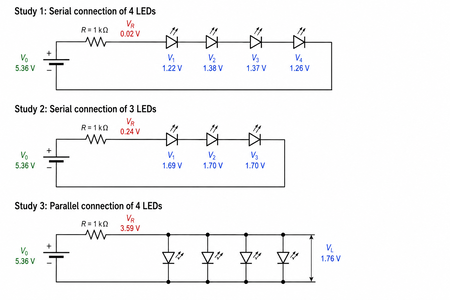
§ Study 1: serial connection of 4 LEDs
§ Setup
-
Source voltage: $$ V_{0} = 5.36V $$
-
Resistor: $$ R = 1k\Omega $$
-
Four LEDs connected in series.
§ Measurements
Measured voltages:
§ Verification using Kirchhoff's voltage law
The remaining \(0.11V\) is likely caused by measurement error, internal resistance, or rounding.
§ Observations
The LEDs not illuminated.
This makes sense because four LEDs in series consume almost the entire source voltage:
That leaves almost no voltage across the resistor, therefore the current in the circuit becomes extremely small.
§ Study 2: serial connection of 3 LEDs
§ Setup
-
Source voltage: $$ V_{0} = 5.36V $$
-
Resistor: $$ R = 1k\Omega $$
-
Three LEDs connected in series.
§ Measurements
§ Verification using Kirchhoff's voltage law
§ Observations
The LEDs illuminated, but noticeably weaker than expected.
Compared to the previous experiment, removing one LED increased the voltage available on the resistor:
This means more current could flow through the circuit.
§ Study 3: parallel connection of 4 LEDs
§ Setup
-
Source voltage: $$ V_{0} = 5.36V $$
-
Resistor: $$ R = 1k\Omega $$
-
Four LEDs connected in parallel.
§ Measurements
§ Verification using Kirchhoff's voltage law
§ Observations
The LEDs illuminated brightly.
Unlike the serial circuits, each LED branch received approximately the same forward voltage:
A much larger voltage remained on the resistor, therefore the circuit current was significantly higher.
§ Conclusions
This experiment demonstrates very clearly how voltage distributes differently in serial and parallel LED circuits.
In the serial configuration, the forward voltages of LEDs add together:
With four LEDs connected in series, their combined forward voltage nearly reached the supply voltage. Almost no voltage remained for the resistor, so the current became extremely small and the LEDs barely illuminated.
Reducing the number of serial LEDs improved the situation slightly because more voltage became available on the resistor.
In the parallel configuration, every LED branch experienced approximately the same forward voltage independently. The resistor therefore carried a much larger voltage drop, which allowed higher current and much brighter illumination.
The measured sums of voltages matched Kirchhoff's voltage law with relatively small errors:
The errors remained within roughly \(0.01V\text{ -- }0.11V\), which is reasonable for manual measurements using a multimeter.
GitHub comments